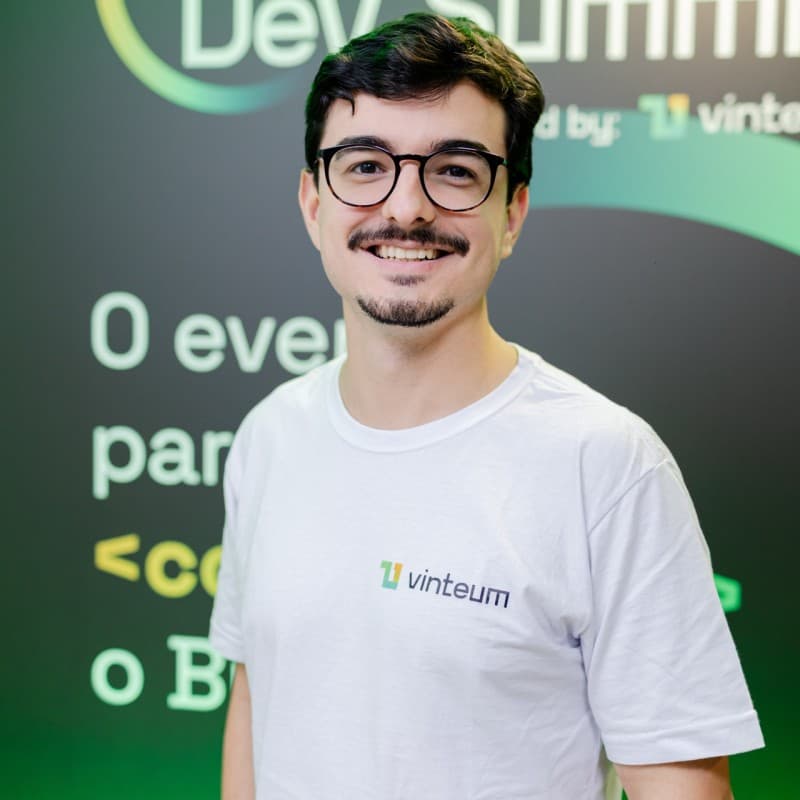
Bruno Garcia was working as a software developer in the automotive industry when Lucas Ferreira, the Brazilian developer that would later found Vinteum, first contacted him. Bruno was active in the blockchain industry at the time — he had also worked for some exchanges back then — and was contributing to open- source projects, always looking at the technological side of things. Lucas wanted him to join a series of Socratic Seminars held by Chaincode Labs. His goal? Getting more Brazilian developers to contribute to the Bitcoin open-source ecosystem.
That call was the beginning of Bruno’s career in Bitcoin- related Free and Open-source Software (FOSS). Chaincode Labs’ program was an online cohort where several developers met weekly to discuss specific topics concerning Bitcoin development. When discussing Taproot, Bruno thought the topic was really interesting, but thought that it would be better to actually learn from the Bitcoin Core code itself. Thus, he started looking directly into the code and in the attached tests. Something happened, though. He found a bug in the functional tests, opened a Pull Request (PR) on GitHub to solve it, and got it merged. There was a huge buzz around that PR, not because of technical reasons, but because Bruno was the first Brazilian developer to ever get a PR merged in Bitcoin Core. A first step towards a less centralized development ecosystem, which had been historically based in the United States.
Fixing that bug in the functional test bootstrapped his career as an open-source developer. He started contributing to Bitcoin Core more and more regularly, while continuing to work in the automotive industry.
After a part-time grant from Brink, Lucas wanted Bruno to become the first grantee completely funded by Vinteum. He went far and wide to find economic support for Bruno and finally got him another grant to work full-time on FOSS. Bruno joined Vinteum as their first grantee ever in the summer of 2022 and took on the role of Board Member and Director of Education.
Bruno has been an [OpenSats LTS grantee][bruno-garcia-lts- grant] since 2024, following support from Brink and Vinteum. Thanks to this financial support, Bruno is able to focus on the fundamental work he is doing for Bitcoin with a long- term time horizon.
—
I'm father, husband, perhaps an amateur athlete, a musician, Brazilian, software engineer and researcher. Nothing super special, just a guy trying to build a better world for everyone (and strongly believe in Bitcoin and open source for this) while living an ordinary beautiful life.
Bruno is a simple guy. When he is not looking for bugs in Bitcoin, he is busy taking care of his family, playing with his son, running and cycling — he says he is an amateur athlete —, or at church.

He has always been interested in the tech world. As a curious high-school student, he started his programming journey working on robots. “I found it fascinating that you could write some code and immediately see it interact with the physical world,” he says. Programming quickly became a hobby and he started experimenting in different areas on his own.
Open-source came later in his life. He was intrigued by the possibilities shared knowledge can bring: Learning by looking at what other people built and making your work useful for others. He sees open-source as a “very powerful way of learning and contributing to the world.” People with very different backgrounds come together to discuss ideas, review each other’s work, and build things in public. “That philosophy resonated a lot with me, and eventually it became a big part of how I approach software development and, later, Bitcoin,” he adds.
But at some point I realized that what makes Bitcoin really interesting is that it does not rely only on technical mechanisms to make the system work. It also relies on incentives. That changed my mind.
Bitcoin entered his life way before he started working on it. He was quite active in local groups in Brazil, but he was mostly looking at the technical side of it — “the cryptography, the networking, the distributed systems aspects.” However, what really made it click for him was diving into game theory: The idea that you don’t need any technical mechanism to enforce rules, but simply rely on the incentives to make the whole system work.
—
Sometimes finding a subtle bug, improving a test framework, or making it easier for future developers to verify a change can have a huge impact without being very glamorous.
Testing software can seem like the least rewarding career path. Instead of working on some new cool features, new consensus changes, or novel research topics — the “rockstar” stuff —, you spend most of your time diving into other people’s work looking for issues. Bruno is not convinced, though. He doesn’t think that a contribution is more valuable just because it is more visible. On the contrary, he thinks that what he does can have a huge impact, especially in Bitcoin.
In many kinds of software, a bug is inconvenient. In Bitcoin, a bug can have consequences for people's money, network interoperability, or even consensus. And because the software is highly adversarial, you have to assume that every edge case will eventually be exercised.
He was already focusing on testing before entering the Bitcoin space. His academic background and research focus was on testing and finding ways of exposing bugs automatically. “It was natural for me to look at [Bitcoin] through that lens,” he points out. The story about his first contribution to Bitcoin Core confirms it.
His work on Bitcoin Core mainly focuses on strengthening how the codebase is tested, mainly through fuzzing and mutation testing. The former is a testing technique that consists in feeding the software with random inputs or malformed data to find possible edge cases and bugs. The latter is a way to evaluate how good a test is, by making small, faulty changes in the code — called mutants — to see if tests fail or not.

He has also been working on Bitcoinfuzz, an implementation of differential fuzzing for Bitcoin-related software. While simple fuzzing looks for bugs in a single codebase, differential fuzzing checks for discrepancies between different implementations of a protocol. It feeds the same random input to multiple codebases to verify that they keep the same behavior.
Thanks to his work on Bitcoinfuzz, Bruno was able to find more than 90 bugs, inconsistencies, and mismatches between different implementations of Bitcoin, Lightning, and related software. A huge impact on the ecosystem.
—
A global decentralized protocol should also have a broad and decentralized base of people who understand it deeply enough to maintain, review, and challenge it.
All the work that Bruno does for Bitcoin seems to follow the same objective: Making Bitcoin more resilient. Developing testing tools is one way to do it. The other is certainly through education. He is convinced that for Bitcoin to thrive, its contributors “should be distributed not only geographically, but also culturally and economically.”
Bitcoin benefits from protocol developers, of course, but also from people coming from software testing, formal methods, distributed systems, economics, security, UX, and education.
Diversity also lies in the different expertise involved. Bruno thinks that valuable contributions can come from people bringing techniques and thinking outside of the usual schemes of Bitcoin development.
He sees the need for these expertise to actually be created locally. “If Bitcoin is supposed to be a decentralized, global system, then ideally its development should not be concentrated in a handful of companies, cities, or countries.” Bruno thinks that having contributors in places like Brazil can make the ecosystem stronger, more diverse, and, as a consequence, stronger.
That is where education fits into what we do at Vinteum. The goal is not just to teach people what Bitcoin is, or even just how Bitcoin works. It is to develop people who can eventually participate in the technical community independently: reading the code, reviewing changes, doing research, finding problems, and contributing upstream.
As Head of Engineering, Bruno is helping Vinteum move forward with this vision. Together, they are trying to build a long-term community where every new developer can become a mentor, giving back to the other what he received at the beginning of his journey.
To become a real community, though, a group of people needs a place to gather, at least every now and then. That’s why Vinteum really believes in in-person gatherings and exchanges, and why they decided to create a physical space for that: Casa 21, a hacker house where Bitcoin builders from Brazil — but also from all over the world — can meet, work together, and build the future. Casa 21 seems to have really boosted the community of Brazilian builders, which is now growing fast.
One of the programs he has helped launch at Vinteum is the [Bitcoin Dev Launchpad (BDL)][bitcoin- dev-launchpad], a curriculum Bruno would have loved to join as a novice open- source contributor. Nothing similar was available at the time. The goal is to identify talented programmers, improve their bitcoin knowledge and skills, and provide the means to help them turn into full-time open source contributors.
The protocol is complex, the codebase is large, and a lot of the knowledge “is accumulated through discussions, code review, mentorship, and years of context.” That’s where education fits in, helping engineers get the time, mentorship, funding, and connections they need to contribute to open-source projects, with the goal of making contributing to Bitcoin become a realistic career path for talented people in Brazil.
There is still a lot of work to do, mainly on the knowledge transfer aspect. Most of the historical knowledge is scattered across several platforms, mailing-lists, IIRC channels, and codebases. “Making that knowledge easier to access, while still preserving the culture of learning by doing, would make it easier for new contributors to become effective” — That is the way forward in Bruno’s mind.
—
We have reached a point where we can no longer overlook these advancements.
Bruno is now working with the Red Team — the group of FOSS developers that is leveraging the latest AI models to discover vulnerabilities before attackers do. The goal is always the same: making Bitcoin more resilient.
That is becoming more and more difficult in the age of AI. Bruno thinks that developers need to stay on top of the latest advancements happening outside of our ecosystem, particularly on LLMs. “By the time we gain access to the [latest] models or secure the funds to use them, malicious actors are already using them to exploit our applications,” he says.
He is now looking into how to leverage these new technologies. He noticed that Bitcoin Core sometimes implements some useful behavior around a BIP, but that is not clearly defined in the BIP itself. His idea would be to develop a sort of harness of differential fuzzing and LLMs, which would allow him and other maintainers to analyze and find these discrepancies to improve the BIPs. He says he is already working on a proof of concept, though it deems it too immature to be shown.
—
What helps more is remembering that the work has a purpose. If I improve a test, find a bug, help someone understand the codebase, or help a new developer become a contributor, that is a small contribution to making Bitcoin more robust and more sustainable.
Curiosity and purpose. These are the things that make Bruno go on everyday. “Bitcoin is one of those systems where the more you learn, the more you realize there is still a lot to understand,” he says. Curiosity drives him to find the next edge case, understand why something was built in a certain way, and design a new solution.
On the tougher days, though, curiosity might not be enough. He needs to remember that there is an important purpose behind what he is doing. Bruno knows that reliability of Bitcoin software matters, that any small contribution can make it more robust. And by making Bitcoin more robust, he knows he is working to make the world a better place.
He is proud of everything he has been doing for Bitcoin — every Bitcoin Core contribution or PR review, for example. However, he is particularly fond of all the work he has done that started as a simple research project but evolved into something able to find real bugs and edge cases.
And even when the work seems to lead nowhere — or the progress seems too slow to feel useful — he tries to remember one of the important lessons of FOSS. The work you do is cumulative, and it becomes part of something that other people can inspect, improve, and build on.
Sometimes a small improvement, a careful review, or helping someone else move forward is already meaningful.
Bootstrapping and growing a Bitcoin development community in Brazil is another thing to be proud of — and probably as meaningful as the technical work.
Helping create an environment where Brazilian developers can contribute upstream, interact with experienced Bitcoin developers, and see Bitcoin open-source development as something they can realistically pursue is very meaningful to me.